Background
Hata Tsuneharu (幡恒春 1883-1944) was born in Miyazu, Hyôgô Prefecture. His given name was Hata Harumichi. He was a pupil of Inano Toshitsune (稲野年恒 1858-1907) and lived in Osaka. He began working at the Osaka Mainichi Shinbun (大阪毎日新聞) newspaper in 1906, where he served as an illustrator for 16 years. He also produced illustrations for the novels of Murakami Noroku (村上浪六 1865-1944).
The set titled Hanshin meisho zue (Pictures of celebrated places in Osaka and Kobe, 阪神名勝図絵), 1916) consists of thirty ôban-size views near or in Kobe and Osaka, plus a map in antique Japanese style showing the location of the scenes and a list of contents. Information specific to each design is also given. Hanshin meisho zue was first issued in a series of portfolios and then later as folding albums. Each of the portfolio covers has a small printed landscape by Akamatsu Rinsaku pasted to it. This set was one of the ambitiously illustrated travel-books produced by the publisher Kanao Tanejirô under his Bun'endô imprint (Kanao Bun'endô 金尾文淵堂), at that time based in Tokyo. Here he used five artists, all employed as illustrators by the Osaka "Asahi Shinbun" newspaper. The five artists were Noda Kyûho (野田九浦 1879-1971), Akamatsu Rinsaku (赤松麟作 1878-1953), Hata Tsuneharu (1883-1944 幡恒春), Mizushima Nihofu (水島爾保布 sometimes called Nihou, 1884-1958) and Nagai Hyosai (永井瓢齊 1882-1945). All the designs were carved by Okura Hanbei (大倉半兵衛; d.1925) and printed by Nishimura Kumakichi II (西村熊吉), the latter working frequently with Bun'endô.
Mitchell (ref. below, p. 118) concluded that, "the Hanshin prints appear to be the very first of all shin hanga landscapes," preceding by two years the first landscapes issued by the publisher Watanabe Shôzaburô (渡辺庄三郎 1885-1962). Jack Hillier (ref. below) notes that the five artists who contributed to the series seemed less influenced by early Japanese print artists than by "western masters who adopted the Japanese techniques of print-making - for instance, Henri Riviere or P.A. Isaac in France." Helen Merritt suggests that the fluid brushwork found in the prints compares with that of the Maruyama-Shijô painterly tradition.
Complete sets mounted in albums can be found in the collections of The British Museum and the Smithsonian Museum of Asian Art (former Pulverer Collection). Ashiya City Museum and Kobe City Msueum.
Note: Loose sheets from portfolio folders are larger and more desirable than sheets from albums, as they were never been trimmed and backed. All our sheets come from folders. Complete portfolio sets (consisting of 6 folders with five prints each) are rarer than the 30-sheet albums (there is additional imagery on the cover of each individual folder) and that format is what can be found in the collections of Ashiya City Museum and Kobe City Museum.
Design
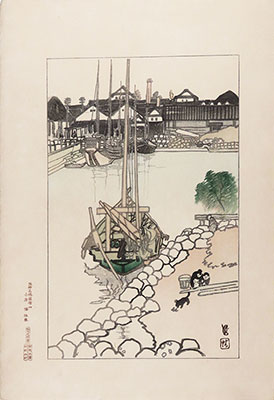
Hata's Imazu design was the fourth in the series. An anchored boat at a stone jetty is the central subject. Ither boats can be seen in the background, as well as a few small figures and a dog in the foreground. The stones receding into the middle ground of the pictorial space add a feeling of rhythm and movement into what is otherwise a still and calm scene. Hata's view of Imazu is a good example of the technical finesse achieved throughout the series. Mitchell proposes that Bun'endô's continual insistence on "very high standards" for all of his publishing ventures became problematic and "he constantly faced bankruptcy because of high operating costs."
Prints from this series are rather scarce, and complete sets are rare.
References:
- Hillier, Jack: The Art of the Japanese Book. London: Sotheby's Publishing, 1987, Vol. II, pp. 1005-1008.
- Helen Merritt, Modern Japanese Woodblock Prints: The Early Years. Honolulu: University of Hawai'i press, 1990, pp. 33-35.
- Merritt and Yamada: Guide to Modern Japanese Woodblock Prints, 1900-1975. Honolulu: University of Hawaii Press, 1992, pp. 31.
- Mitchell, Charles H.: "Hanshin Meisho Zue: A Little-known Early Shin Hanga Series," in: Essays on Japanese Art Presented to Jack Hillier, 1982, London: Robert Sawyers Publishing, pp. 118-124.


 Return to