Background
Tôkyo (東居 or 東挙), 1828-1869, was a gô (art name: 號) used by Umegawa Tôkyo (梅川東居 or 東挙). He lived and worked in Kyoto, producing nihonga (Japanese-style painting: 日本画) as well as landscape and figure prints in the ukiyo-e style. His paintings show the influence of the Maruyama school. Tôkyo's students included Nomura Bunkyo (野村文挙, 1854-1911) and Imao Keinen (今尾景年, 1845-1924).
Design
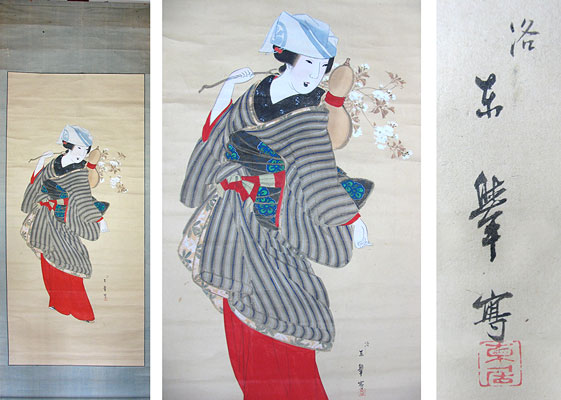
The young woman is engaged in sakuragari (lit., cherry-blossom hunting, i.e., looking for cherry blossoms: 桜狩 or 櫻狩), a favorite seasonal pastime. To keep warm, she wears a quilted striped jacket worn over a vivid red robe, a hue so "heated" that it imbues this portrait with an erotic subtext.
The verso of the painting is inscribed Ôkyo monjin (pupil of Ôkyo: 応挙門人), that is, Maruyama Ôkyo (円山応挙, 1733-95), a key figure in the history of Japanese art and founder of the Maruyama school of painting. However, as Tôkyo was born after the passing of Ôkyo, one must accept this inscription as an indication that Tôkyo was a disciple of the Maruyama school.
References: Roberts, A Dictionary of Japanese Artists, p. 181; Mitchell, Illustrated Books of the Nanga, Maruyama, Shijô, and Other Related Schools of Japan, p. 190.


 Return to