Background
Gigadô Ashiyuki (戯画堂芦幸 active c. 1813–33) was an important early innovator within the Kamigata school of printmaking. A pupil of Kyôgadô Ashikuni (狂画堂芦國 act. c. 1801–20), Ashiyuki also signed with the name Nagakuni (長國 c. 1814–21)
The prolific Ashiyuki appears to have been the first to combine Shijō-style painterly elements (possibly derived from illustrated books, ehon, of the period) with the more densely colored ukiyo-e (浮世絵) manner of rendering figures. He might also have been the earliest Kamigata (Kyoto-Osaka, 上方) print artist to use "shell powder" (gofun: 胡粉) for snow and, on full-color single-sheet prints (nishiki-e: 錦絵), to have printers use color blocks without outlines for the forms. His chûban-format designs (中判 approx 250 x 180 mm) and horizontal ôban compositions (大判 approx. 370 x 280 mm) were among the earliest of their kind in Osaka.
Design:
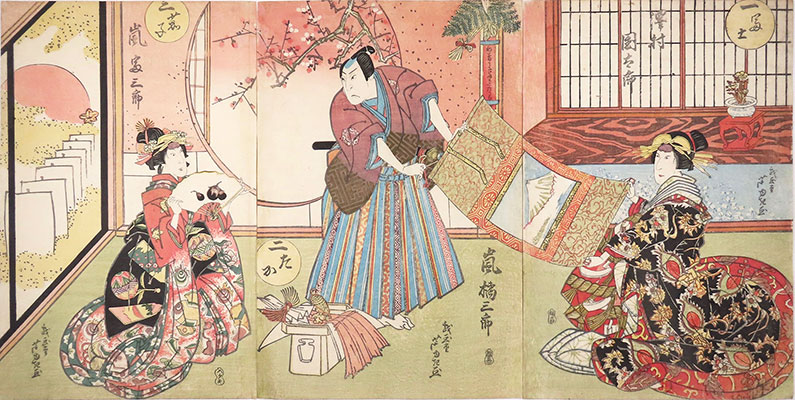
The assumption is that this triptych ia a "analog print" (mitate-e), and thus not an actual scene with these three actors. Their names are inscribed on the three sheets, but there are no role names included, and an identification of a play remains elusive.
Auspicious New Year symbols — Mount Fuji on the painting, a hawk on the lacquer tray near Kitsusaburô II, and eggplants painted on Tomisaburô's folding fan, signal good luck if the first dream of the New Year included these harbingers of good fortune. The yellow circles name the positional numbers of the sheets and the three objects: One, ichi-Fuji 一富士; two, hawk, ni-taka ニ鷹; and three, san nasubi, 三茄子, eggplant, (nasu ナス). The women's kimono are elaborately decorated, while Rikan's kimono is of a restrained design. The floor screen on the far left is painted with seven ship's sails below a rising sun.
By this time, Osaka artists had settled on a consistent facial likeness (nigao) for Rikan, as here, and Ashiyuki was among the first to do so a few years earlier.
There is another impression of this print illustrated in Dean Schwaab, Osaka Prints, p. 132-33, no. 117. This design is not, however, listed in the catalogs for the three large Japanese institutions featuring kamigata-e (Ikeda Bunko Library, Waseda University, and Konan Women's University).
References: OSP, no. 117


 Return to