Background
Very little is known about the artist . His biography remains a mystery, and his prints are scarce. In fact, after twenty years of offering Osaka prints, this is the first time we have for sale a woodblock print by Nobuharu.
A tengu (天狗) or "heavenly dog” is a term derived from a dog-like Chinese demon (Tiangou 天狗). It is a goblin of great strength and cunning, often depicted with a long nose and said to live in mountain forests (yamabushi tengu 山伏天狗), especially among cryptomeria (Japanese cedar). One type was the tree-foliage goblin (ko no ha tengu 木の葉天狗), with human form, wings, and a very long nose. Another type was the crow goblin (karasu tengu 烏天狗), combining human and crow-like characteristics with a bird’s head and curved beak. Karasu tengu may be seen holding ring-tipped staffs known as shakujo. Tengu was also slang for someone who brags or boasts (braggart).
Design
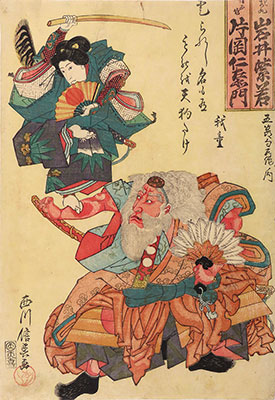
Ushiwakamaru (later Minamoto no Yoshitsune) is a legendary samurai figure who, according to folklore, was trained for many years in swordsmanship, strategy, and supernatural martial arts by Sôjôbô, the king of the tengu on Mount Kurama in northern Kyoto. Seeking vengeance for his clan, the young boy mastered skills—such as incredible leaping ability (shown in Nobuharu's print, with his left foot perched on Sôjôbô's right arm), a skill that enabled him to become one of Japan’s most celebrated warriors.
The tengo Sôjôbô holds magical ha-uchiwa (羽団扇), a fan made of feathers. In folk tales, these fans sometimes have the ability to grow or shrink a person's nose, but usually they are said to possess the power to stir up great winds.
The poem by the actor Kitaoka Nizzaemon reads: "Though he already has a name that has risen high, still—tengu bamboo." (Noborareshi na mo aru mono o, tengu-take 登られし名も有ものを天狗たけ). "Tengu is the Sôjôbô king who gives fencing lessons to the seven-year-old Ushiwakamaru."
This appears to be a rare design, as we know of very few other impressions (See SDK below).
References: SDK, p. 112, no. 236


 Return to